
FUE hair transplantation
FUE hair transplantation
a proven, minimally invasive method in which hair follicles are extracted from strong areas of your scalp (back and sides) and then aesthetically implanted into balding areas.
Winter promotion – 7 PLN per graft + discounts on larger procedures
About the FUE procedure
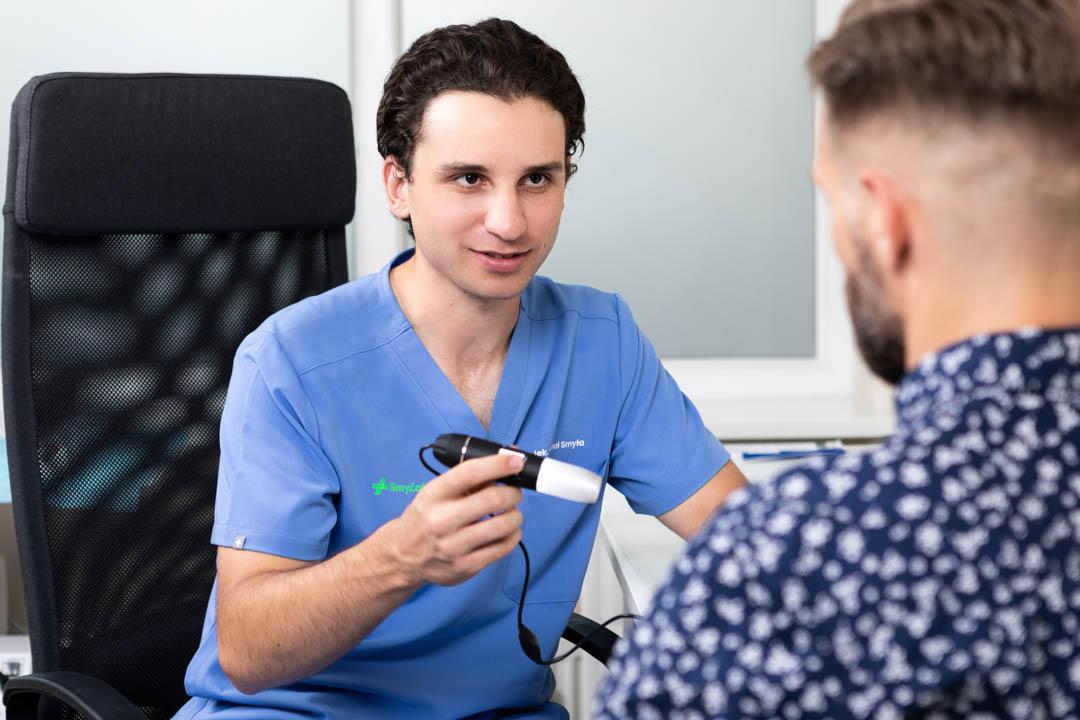
1. Consultation
Before the procedure, we will help you choose the optimal hairline and determine the safe amount of follicles to be transplanted.
The consultation includes:
- preoperative interview,
- videodermatoscopic examination,
- determination of the safe donation area,
- drawing your new hairline.
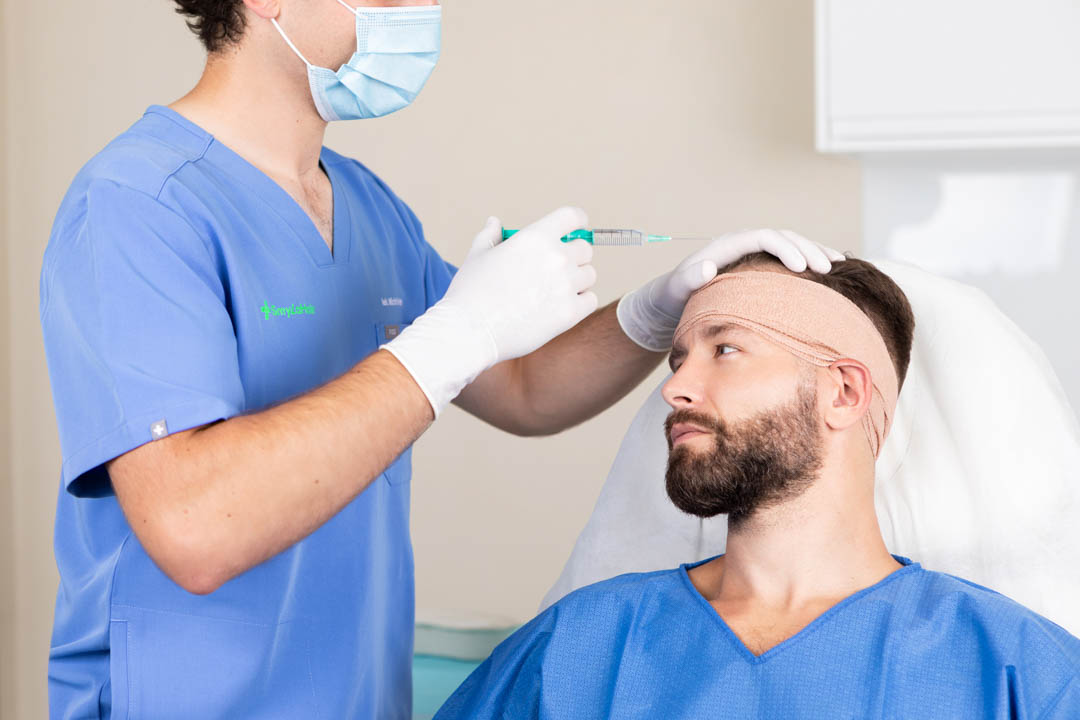
2. Anesthesia
The procedure begins with the administration of anesthesia to the donor and recipient area.
FUE hair transplantation is:
- performed entirely under local anesthesia,
- virtually painless.
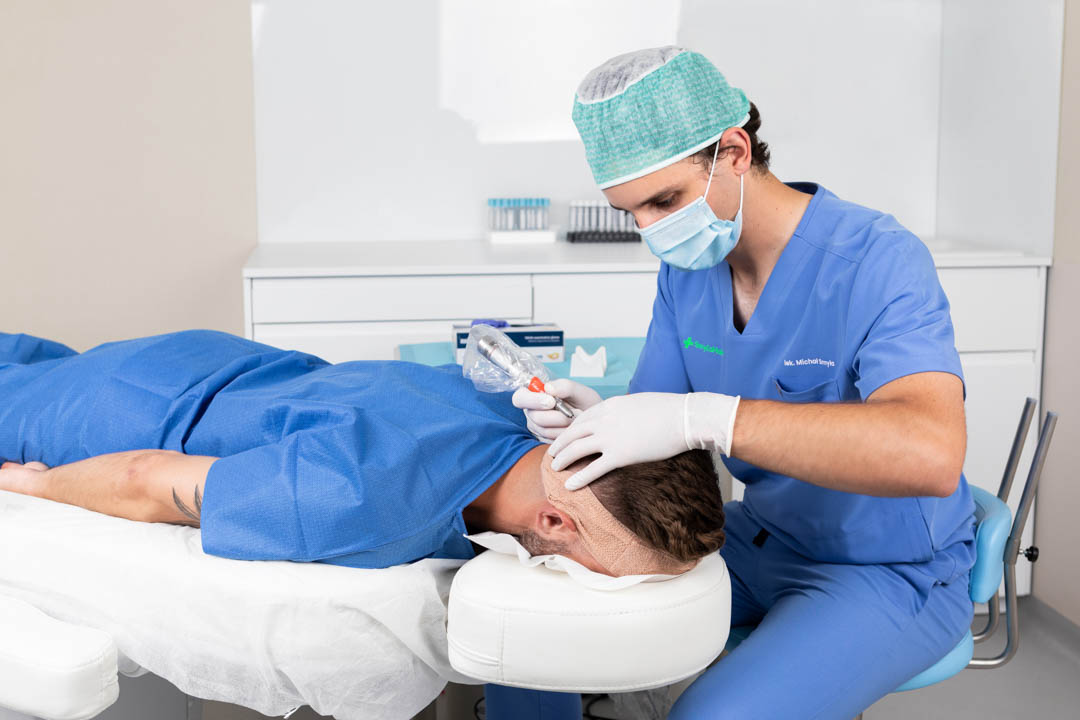
3. Follicle harvesting
The next step is the harvesting of follicles:
- They are harvested using small-diameter, trumpet-shaped punches (0.7-0.9 mm).
This makes the donor sites almost invisible about a week after the procedure, - are taken only from a pre-marked safe donor area.
The rest of the team prepares the follicles for implantation:
- assesses and sorts them based on thickness and hair count,
- transfers them to a holding solution and cools them.
4. Recipient site creation
We prepare incisions for the frontal part of the hairline where the single-hair follicles will go.
This stage is particularly important to us. Beyond technique, it requires maintaining aesthetics—so that the result achieved for you is as natural as possible.
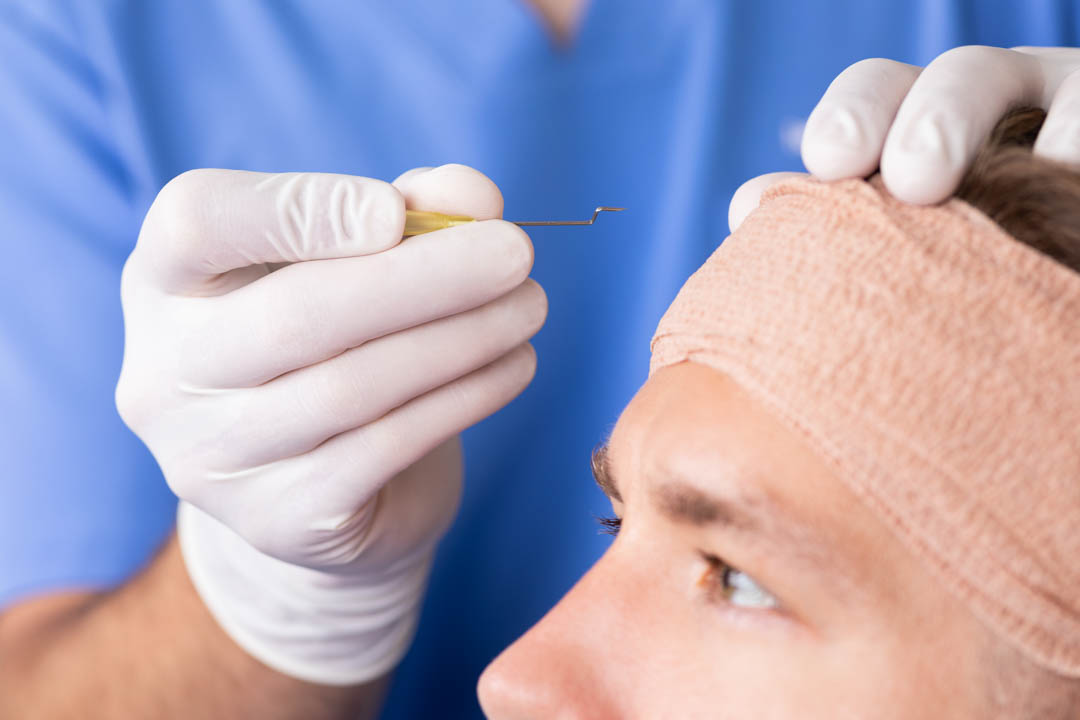
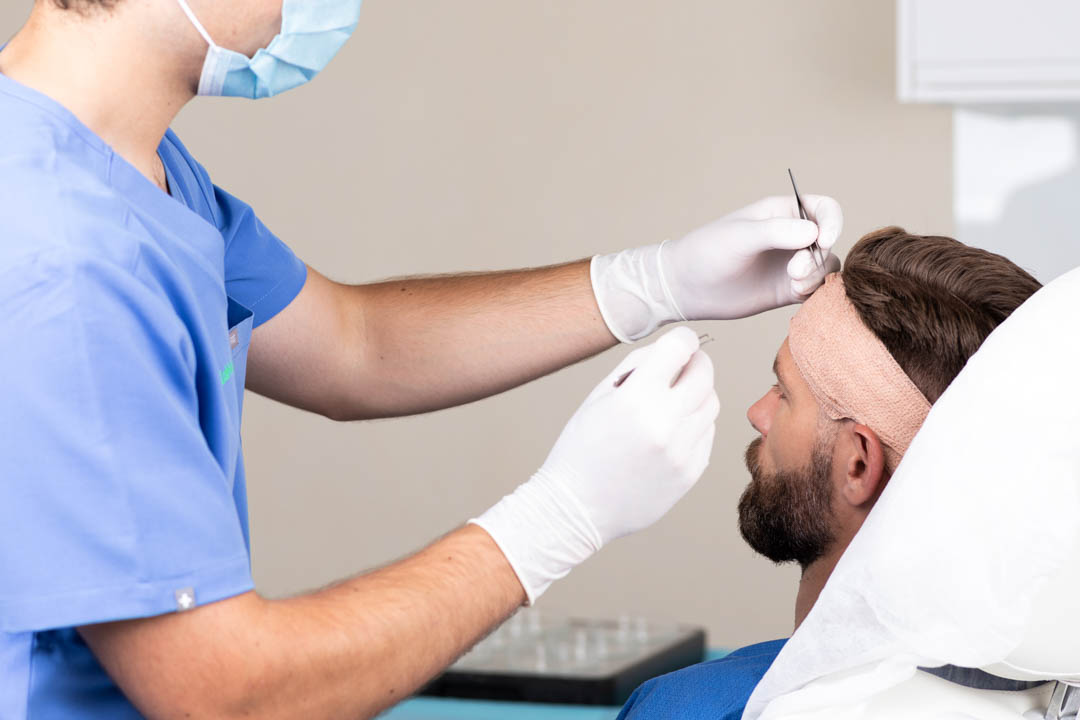
5. Follicle implantation
In the final step, the follicles are implanted one by one using implanters.
- The follicles go into the appropriate areas depending on how many hairs they contain – the goal is to achieve the most natural look.
- The follicles are implanted only with implanters, reducing the risk of damage and reducint graft out-of-body time.
Success!
Am I a good candidate?
If you are at least 25 years old and do not suffer from serious chronic diseases, you are most likely a good candidate for FUE hair transplantation.
Want to be sure?
Get a free, no-obligation consultation.
We’ll get back to you within 24 hours.
The administrator of the data is us, i.e. Michał Smyła NIP 6462963492 with registered office at 36 Niepodległości Avenue, 43-100 Tychy. The data will be processed in order to respond to your inquiry in accordance with the regulations.
Or fill out the online consultation form:
Online consultation
Within 24 hours you will be contacted by a doctor and presented with treatment options.
Price list
Hair transplantation
FUE hair transplantation
popular
8 PLN
7 PLN / graft (follicle)
£1.20 / graft
promotion
For example:
Temporal recessions
8–14 thousand PLN
Crown (tonsure)
8–14 thousand PLN
Front half of the head
15–18 thousand PLN
BHT Hair Transplant (Body Hair Transplant).
£1.50 / graft
Beard transplant
£1.50 / graft
Consultation
free of charge
Price includes:
- Post-op care kit
- Meal and beverages
Frequently asked questions
Frequently asked questions
Hair transplantation is a medical procedure in which follicular units—naturally occurring groups of 1 to 4 hairs—are extracted from genetically strong areas (back and sides of the head—donor area) and transferred to balding or bald areas: front, top, and crown of the head (recipient areas), where they grow for life.
The cost of an FUE hair transplant at SmylaHair clinic is £1.50 per graft (current promotion – £1.20 / graft). A graft means a follicular unit, which can contain, on average 2-3 hairs.
For example:
- Small procedure (1000 grafts): £1190
- Medium-sized procedure (2500 grafts): £2990
- Large procedure (4000 grafts): £3990
FUE hair transplantation is an almost painless procedure – it is performed under local anesthesia from start to finish.
Some patients may experience minor pain after the anesthesia has worn off – but it is easily controlled with over-the-counter pain medications.
FUE hair transplantation leaves no linear scars.
The areas from which the follicles were taken are very small in diameter (0.7-0.9 mm) and become almost invisible after only about a week after the procedure.
Yes. The effects of FUE hair transplantation are permanent – the transplanted hair will not fall out.
If you are at least 25 years old and do not suffer from serious chronic diseases, you are most likely a good candidate for a hair transplant.
However, only a consultation with a doctor will give you complete certainty.
SmylaHair offers free, no-obligation online consultations – we will respond within 24 hours.
The two main methods of hair transplantation, which differ in how the follicles are harvested, are:
- FUE — Follicular Unit Extraction — a newer, minimally invasive method in which hair follicles are extracted individually, one by one, directly from the scalp (back and sides of the head). Using blades with a diameter of 0.7–0.9 mm, the surgeon makes incisions around the hair follicles, allowing them to be extracted. Small openings remain in their place, which heal within a few days after the procedure, leaving almost no trace.
- FUT (STRIP) — Follicular Unit Transplantation — an older method in which the surgeon uses a scalpel to remove an elongated strip of skin along with subcutaneous tissue from the back of the head. The strip is then precisely divided under a microscope into individual follicular units.
The follicular units, regardless of how they are harvested (FUE/FUT), are then implanted in the balding areas in the same manner.
Advantages of FUE hair transplantation:
- The treatment does not leave linear scars
- It is near-painless
- Short recovery period
- It is possible to take grafts from areas such as beard, chest
Disadvantages of FUE hair transplantation:
- The procedure takes longer than a FUT transplant (STRIP)
- It is more expensive than FUT (STRIP) transplantation
Depending on the extent of the procedure – FUE hair transplantation takes from 4 to 12 hours.
You can check the exact course of the entire procedure here.
The holes on the back of the head heal after 3-5 days after the procedure, the transplanted hair takes a little bit longer (up to 10 days).
Depending on the type of work you do, you can return to it even the next day. However, most patients allow 3–5 days for recovery.
A week after the procedure, you can return to moderate physical activity.
You can find the exact post-treatment instructions here.
A few days before the procedure, you should not consume alcohol, smoke tobacco, or take medications containing acetylsalicylic acid (Aspirin). You should also have laboratory tests performed.
You can find detailed instructions on how to prepare for the procedure here.
In the first days after the procedure, transplanted hair should be sprayed with the aerosol you will receive from us. Avoid scratching or prolonged exposure to sunlight.
You can find detailed instructions for post-procedure management here.
Tips before and after the procedure
Before treatment
Research, which you must make at 10 days before treatment:
- Morphology
- Glycemia
- Coagulogram (APTT and INR)
- General urinalysis
- Serological tests:
- HIV (Combo)
- HBV (HBs antigen)
- HCV (anti-HCVantibodies).
Email the results tous(info@smylahair.com) and bring them withyou to the treatment.
7 days before treatment:
- Do not take anymedicationcontainingacid acetylsalicylic (Aspirin) on 7 days before i 7 days at procedure. Many over-the-counter medications may contain acetylsalicylic acid, e.g., Aspirin, Etopiryna, Polopiryna, Acard, Polocard, and others.
- Do not take any painkillers/anti-inflammatory medications for 7 days before the procedure, e.g., Ibuprom, Naproxen, Diclac. If you must take a painkiller, you can use paracetamol (Apap).
- Do not takesupplements diet,including herbal, and B and E vitamins on the 7 days before i 7 days at procedure. These substances can increase bleeding and interact with anesthetic agents. For example, do not take: cod liver oil, melatonin, green tea, garlic extract.
- Discontinue all forms ofuse oftobacco at 2 weeks before and 2 weeks after treatment (cigarettes, chewing tobacco, but also smoking cessation aids—e.g., patches, Niquitin gum). Nikotyna w każdej postaci może znacznie opóźnić proces gojenia.
- Cessationń drinking alcohol (wjointlyconnectąincluding beer and wine) at 48 hours before i 48 hours after surgery.
- Medications taken regularly: Take medications as prescribed by your doctor (e.g., medications for hypertension, asthma, finasteride).
- If you are taking medications for arthritis (e.g., rheumatoid—RA), inform us before the procedure for additional qualification.
- If you have diabetes, on the day of the procedure bring your glucometer.
- If you have asthma, on the day of the procedure bring your inhalers.
- If you use Loxon (minoxidil), cessation ofń its use on 2 days before surgery. You canżer returnć to use Loxone 7 days after treatment.
- Wash włosy in the morning on the day of the procedure. Dry them and do not apply any additional products (e.g., gel, styling paste, conditioners).
On the day of surgery
The morning of the day of the procedure:
- Wash your hair. Dry them and do not apply any additional products (e.g., gel, styling paste, conditioners).
- Eat a normal breakfast.
- Wear comfortable clothing that easily goes over your head (e.g., a shirt, zip-up hoodie). You can also bring a loose head covering.
- Take your test results and medications (if you are taking them permanently) with you.
After treatment
General guidelines
- The effects of medications used during the procedure may persist for 24 hours after the procedure. Symptoms may include drowsiness, dizziness, disorientation, nausea, redness/irritation of the scalp. If you experience any of these symptoms, we recommend that you remain under the care of an adult for 24 hours.
- Drink plenty of fluids. You can resume eating meals immediately after the procedure—there are no dietary restrictions.
- Pain after the FUE procedure is rare, but in case of pain, take Ibuprofen 400 mg every 8 hours (after meals). Exercise caution if you have or have had stomach conditions, especially peptic ulcer disease. You can also take paracetamol (Apap).
- Do not drink alcohol for 48 hours after the procedure.
- Contact us if you experience the following symptoms:
- Pain that does not go away after taking the maximum dose of pain medication.
- Bleeding from the surgical site that does not stop after compression for 5 minutes
- Fever above 38.0°C up to 7 days after the procedure
- Signs of surgical site infection, such as severe redness, swelling or pain, yellow/green exudate
- Body rash
- Nausea and vomiting that do not go away after taking antiemetics
- Call 112 if you experience swelling of the lips, tongue or throat that makes it difficult to breathe
The first night after the procedure
What to expect
- The scalp will be reddened
- On the back of the head (donor area) will be visible small This is normal, it will heal up to 3 days.
Hair and scalp care
- Do not wash your hair for more than 24 hours after
- Start spraying the transplanted hair with the aerosol you will receive from us – in the first day spray every 20 You can put a towel on the shoulders to drip excess liquid on it.
Food
- Eat dinner. There are no dietary restrictions
- Do not drink alcohol for 48 after the procedure.
Dream
- Sleep with your head elevated—using two pillows. Discharge may appear from the donor area (back of the head), so we recommend placing a dark towel on the pillows.
Day 1 after the procedure
What to expect
- Redness of the scalp will fade, but may still persist.
- Scabs may appear, which will disappear by 10-14 days.
Hair and scalp care
- Do not touch, scratch or rub the transplanted hair, and avoid prolonged exposure to the sun.
- Spray the transplanted hair with a spray every 1-2 hours.
- You can wash your hair, but wait until evening. Wash your hair gently, using normal shampoo and low water pressure. Dry your hair only by patting with a towel, preferably disposable (do not rub), and comb your hair only with your fingers (do not use brushes or combs).
- On the donor area (back of the head), you can apply a wound healing cream, e.g., Cicatridina.
Physical activity
- Limit physical activity.
Dream
- Sleep with your head elevated on two pillows.
Days 2–7 after the procedure
What to expect
- Redness/pigmentation of the scalp may persist for up to a week after the procedure.
- Two to three days after the procedure, puffiness may appear on the forehead and around the eyes.
Hair and scalp care
- The transplanted hair is already stronger, but continue to avoid touching, scratching, rubbing and prolonged exposure to the sun.
- On days 2–3, spray the transplanted hair with aerosol every 1–2 hours—or until the liquid is used up.
- Wash your hair gently, dry only by patting with a towel. On day 4, you can start using hair products other than shampoo again. You can use a brush and hairdryer, but exercise caution.
- You can apply vitamin A ointment to the scabs at night.
- If swelling occurs, apply ice to the forehead and/or donor area (back of the head). Do not place ice directly on the transplanted follicles (recipient area). In case of severe swelling, use medications as recommended.
Physical activity
- You can return to light physical activities, such as gentle running, gentle strength training.
- Avoid the pool and sauna for 2 months after treatment.
Dream
- Sleep with your head elevated on two pillows.
Weeks 2–4 after the procedure
What to expect
- You may start losing transplanted hair—this is a normal phenomenon. Shedding can last up to 4–6 weeks. These hairs will regrow within 3–4 months.
- Bumps/pimples may appear in the recipient area. They should disappear on their own, but you can apply Microdacyn spray or antibiotic ointment (e.g., Tribiotic) to them.
Hair care
- You can return to normal hair washing. If scabs persist, stay under the shower longer, use conditioner, and massage the recipient area to remove scabs.
- You can go back to using Loxone and LLLT laser.
- After 10 days from the procedure, you can cut or dye your hair.
Physical activity
- You can return to full activity
Months 2–3 after the procedure
What to expect
- Transplanted hair begins to grow. During this period, existing hair may start to fall out—this is a normal phenomenon; these hairs will regrow.
- During the period of intensive growth of transplanted hair, irritation of the recipient area may occur, which will disappear spontaneously after most of the transplanted hair grows out.
Hair and scalp care
- Avoid overexposure to the sun’s rays (use headgear or SPF filters).
6 months after surgery
What to expect
- The transplanted hair is getting thicker,
Hair and scalp care
- Avoid overexposure to the sun’s rays (use headgear or SPF filters).
12-18 months after surgery
The final result of the hair transplant is visible. Congratulations!